


Aluminum Foil Jumbo Roll
Aluminum Foil Jumbo Roll
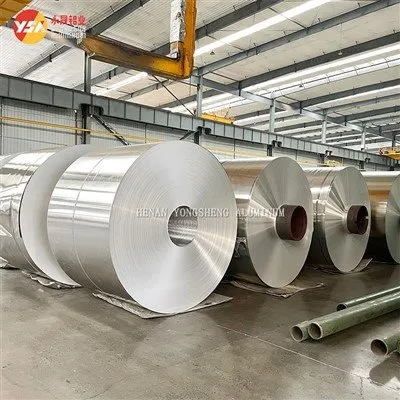
Industrial-grade aluminum foil jumbo rolls engineered for downstream converters, packaging manufacturers, HVAC insulation producers, and industrial processors. Manufactured with tightly controlled metallurgical properties, precise gauge uniformity, and optimized surface tension to ensure high-speed slitting, coating, and lamination performance without web breaks.


Technical Specifications & Available Options
|
Technical Parameter |
Specification / Selection Criteria |
Test Method / Standard |
|
Alloy & Temper |
1235, 8011, 8079, or 3003 (O, H14, H18, H24) |
ASTM B209 / EN 573-3 |
|
Thickness Range |
0.006 mm to 0.20 mm |
Micrometer calibration per ISO 6.1 |
|
Cross-Web Tolerance |
±3% to ±5% across coil width |
Hydraulic Automatic Gauge Control (HAGC) |
|
Surface Wetting Tension |
≥32 dyne/cm (degreased grades) |
Dyne pen test per ISO 8296 |
|
Residual Oil Content |
≤0.5 mg/m² (solvent-cleaned surface) |
Gravimetric analysis via solvent extraction |
|
Pinhole Requirements |
≤0 to 2 pcs/m² (alloy dependent) |
Light table optical inspection per ASTM E426 |
|
Core Inner Diameter |
76 mm (3 in) or 152 mm (6 in) |
Steel or high-strength paper core |
|
Quality Documentation |
Batch-traceable Mill Test Certificate (MTC) |
Physical & mechanical property verification |
Downstream Applications
Flexible Packaging and Lamination
Utilized as a metal foil layer in flexible packaging structures, subject to the requirements of the selected lamination or coating process. Converters specify foil thickness, width, surface condition, and compatibility requirements for solventless or extrusion-lamination systems. For pharmaceutical blister packaging, foil grades are matched to specific barrier and blister-forming requirements.
Household Foil and Aluminum Container Production
Converted into small-format household kitchen foil rolls and stamped into rigid food containers via high-speed mechanical presses. For deep-drawing or stamping applications, material suitability is assessed against actual forming conditions and elongation requirements.
HVAC and Thermal Insulation
Incorporated into insulation facings for fiberglass and rockwool duct boards, pipe insulation wraps, and radiant barrier systems. Available as plain, coated, or laminated composite structures.
Other Industrial Applications
Specialized applications, including lithium-ion battery current collector foil production, require separate confirmation of purity grades, surface cleanliness, and technical specifications.

Our integrated production workflow ensures stable batch-to-batch consistency from primary rolling to final slitting.
Rolling and Annealing
Multi-pass four-high and six-high cold rolling mills reduce stock down to micro-gauges while maintaining flat web profiles. Controlled atmosphere annealing furnaces eliminate work hardening, relieve internal residual stresses, and completely volatilize rolling oils to achieve food-contact hygiene standards.
Slitting and Coil Preparation
Master coils are converted into specified widths using high-precision rotary shear slitters, delivering burr-free edges, exact width tolerances, and stable winding tension to protect high-speed converting equipment.
Inspection and Documentation
Every master coil undergoes physical testing for tensile strength, elongation, pinhole density, surface wetting tension, and dimensional verification prior to release. Each shipment is accompanied by a batch-traceable Mill Test Certificate (MTC).
Packaging and Delivery
Packaging is designed to protect foil against moisture, contamination, deformation, and handling damage during storage and maritime transportation.
Roll Configuration
Horizontal suspension mounting in heavy-duty, fumigation-free wooden crates with steel locking flanges to prevent lateral shifting and telescoping.
Moisture Barrier
Sealed with internal moisture barrier films and silica gel desiccants to prevent oxidation during ocean freight.
Logistics Parameters
Core dimensions, net weight, maximum outside diameter (OD), pallet specifications, and shipping marks are confirmed prior to order execution.
Commercial Terms
Minimum order quantity (MOQ) and production lead times are established based on specific alloy availability and rolling schedules.
Frequently Asked Questions